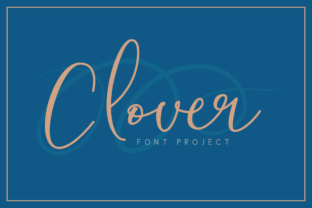
Clover: A Casual Handwritten Font for Flowing Text
When you are choosing a typeface for a project that needs a human touch, the sheer number of handwritten fonts can feel overwhelming. Some lean toward elegant calligraphy, others toward rough sketchiness, and many fall somewhere in between. Clover sits in a specific niche: it is a simple, casual handwritten font designed to help you create flowing, approachable text without the stiffness of formal script or the illegibility of overly stylized handwriting. This article evaluates Clover from a practical standpoint, helping you decide whether it aligns with your project goals, what tradeoffs to expect, and when you might want to look at alternatives.
What Is Clover, Exactly?
Clover is a handwritten typeface built to feel natural and unforced. It models itself on everyday cursive writing, but with enough polish to remain readable at body text sizes. The letterforms are rounded, the strokes are smooth, and the overall impression is light and friendly. Unlike many handwritten fonts that attempt to replicate neat penmanship with a rigid baseline, Clover introduces slight inconsistencies in letter height and slant — just enough to evoke a personal note rather than a printed document.
The font includes both uppercase and lowercase characters, numerals, and basic punctuation. It does not feature extensive ligatures or swashes, which keeps it clean and straightforward. This lack of decorative extras is a deliberate design choice: Clover prioritizes readability and ease of use over ornamentation. For a designer or content creator, that means less time adjusting kerning or worrying about letter collisions.
Why Someone Might Be Interested in Clover
The primary appeal of Clover lies in its balance between personality and functionality. Many handwritten fonts are either too playful to use in serious contexts or too stiff to feel genuinely handwritten. Clover avoids both extremes. It can work in:
- Branding for small businesses — cafes, boutiques, freelance creatives, or wellness brands that want a warm, approachable identity.
- Invitations and event materials — wedding stationery, party invitations, or thank-you cards where a personal touch matters but readability is still key.
- Social media graphics — quotes, announcements, or captions that need to stand out in a feed full of sans-serif and serif text.
- Digital notes and planners — apps, templates, or website backgrounds that simulate handwritten notes for a casual, non-intimidating feel.
If your audience expects a friendly, human voice, Clover can reinforce that tone without overpowering the content. The font’s simplicity also makes it a good candidate for long-form text (like blog posts styled to look handwritten) because it does not tire the eye as quickly as more ornate script fonts.
Natural Flow and Rhythm
The defining feature of Clover is how smoothly letters connect. In a well-set block of text, the font creates a consistent rhythm that guides the reader along. This is particularly useful when you are designing quotes, headlines, or short paragraphs that should feel like someone actually wrote them. The casual slant and variable letter widths add to the organic feel without breaking legibility.
Approachable, Not Distracting
Some handwritten fonts demand attention — they are the star of the design. Clover, by contrast, supports the message. It is recognizable as handwriting but does not compete with the content. For a brand that wants to communicate reliability and friendliness together, that understated presence is a real advantage.
Good X-Height for Readability
Clover’s x-height (the height of lowercase letters relative to capitals) is generous, which improves legibility at smaller point sizes. Many casual handwritten fonts suffer from short lowercase letters that become muddy at 12px or 14px. Clover retains clarity in these scenarios, making it a solid choice for body text in digital invitations or short articles.
Tradeoffs and Considerations
No font is perfect for every situation, and Clover has limitations worth acknowledging before you commit to it.
Limited Character Set
Clover does not include extended Latin characters, diacritics, or advanced OpenType features. If your project requires multilingual support or special typographic flourishes (like stylistic alternates or ligatures to avoid repeated letter shapes), you may find Clover lacking. The font works best in English or other Western European languages with minimal accented characters.
Informal Tone May Clash With Professional Contexts
While Clover is versatile, its casual handwriting style can feel out of place in formal documents such as legal contracts, corporate annual reports, or medical information leaflets. The font’s personality comes from its imperfections, and in contexts where precision and authority are paramount, those same imperfections may read as unprofessional or careless.
Consistency at Very Large Sizes
At display sizes (above 48pt or so), the handmade quality of Clover can start to look uneven. Letterforms that feel natural at paragraph size may appear wobbly or slightly unfinished when blown up. If you need a headline font for posters or banners, you might want to pair Clover with a more structured companion font for the largest text, or test it thoroughly at the intended size.
Lack of Weight Variation
Clover typically comes in a single weight — regular or medium. Without bold or light alternates, you cannot create strong typographic hierarchy solely within the font family. Designers often solve this by combining Clover with a clean sans-serif like Open Sans or Lato for headings and subheadings on digital materials, or with a classic serif for printed pieces.
When Clover Is a Strong Fit
Clover shines in situations where you want to evoke a personal, handwritten feel without sacrificing readability or ease of implementation. Specific use cases include:
- Blog banners and hero images — where the title needs to feel genuine but remain scannable.
- Product packaging for handmade goods — soap, candles, artisanal food products where the word “handcrafted” should be reflected in every design element.
- Children’s content — educational materials, storybooks, or apps targeting young readers benefit from Clover’s friendly, non-intimidating appearance.
- Personal branding — for freelancers, coaches, or influencers who want their visual identity to mirror a handwritten note rather than a corporate logo.
In all these scenarios, the font supports a narrative of authenticity and approachability. The reader is more likely to feel that a human being wrote the text, which can increase trust and engagement.
When Alternatives May Be Worth Considering
If your project demands any of the following, you may want to look beyond Clover:
- High formal polish — a font like Playlist Script or Lemon/Milk (a hybrid) might offer more refinement for wedding invitations or luxury brand materials.
- Extensive multilingual support — for projects that include Central European, Cyrillic, or Asian characters, look for a handwriting font with broader coverage, such as Pacifico or Nanum Pen Script.
- Strong typographic hierarchy within one font family — fonts like Kalam or Amatic SC offer multiple weights (bold, light) so you can use the same family for body and headlines.
- Digital prototype or wireframe use — if you need handwriting in mockups but the font must remain legible at very small sizes (10px or less), a simpler script like Dancing Script might render more clearly on screens.
That said, none of these alternatives replicate Clover’s specific balance of casual flow and modest restraint. Each has its own tradeoffs. For instance, Pacifico is more exuberant and can dominate a design, while Nanum Pen Script has a more Korean calligraphic feel. Choosing an alternative means accepting a different personality for your text.
Practical Decision-Making Insights
To decide whether Clover is the right font for your project, consider these practical steps:
1. Test It at the Sizes and Mediums You Plan to Use
Download the font (or use a web font service) and create a mockup. View it on a desktop screen, a mobile device, and — if applicable — print it at actual size. Pay attention to how the letters look in all caps, in mixed case, and in blocks of text. Does the informal slant still feel appropriate at 72pt for a headline? Does the lowercase ‘a’ or ‘g’ confuse readers at 14pt in a paragraph?
2. Pair It Deliberately
Clover works well with a neutral sans-serif like Montserrat, Work Sans, or Source Sans Pro for labels, navigation, or subheadings. Avoid pairing it with another handwritten font, as that can create visual clutter. A simple serif like Crimson Text can also work for body copy in printed materials, adding contrast while maintaining a readable flow.
3. Check Your Content’s Tone
If your content is instructional, technical, or authoritative, Clover may undercut the seriousness of the message. If your content is inspirational, personal, or community-oriented, Clover will likely reinforce that tone. Make a quick audit of the key emotions your text should convey. If “friendly” and “approachable” are in the top three, Clover is likely a strong candidate.
4. Consider Accessibility
For web use, ensure sufficient contrast between Clover and your background color. Because handwritten fonts can vary in stroke thickness, thin sections might disappear on light backgrounds, especially at smaller sizes. Avoid using Clover for body text in low-contrast settings (like a pastel font on a white background). Also, provide a fallback font like Arial or a generic handwritten stack for users whose devices do not load web fonts.
Final Evaluation: Does Clover Align With Your Goals?
Clover is a practical, well-executed casual handwritten font. It fills a specific role: it looks like natural handwriting but stays readable, it feels personal without being eccentric, and it integrates easily into both digital and print layouts. It is not a Swiss Army knife — it lacks weight variety, extended language support, and decorative features — but within its intended use cases, it performs reliably.
If you need a typeface that supports a warm, human tone and you can work within its limitations, Clover is a strong choice. If your project demands more formality, greater typographic flexibility, or broader character coverage, then you would be better served by a more robust script or a clean handwritten alternative. In the end, the best font is the one that fits the specific content, audience, and medium. Clover fits best where authenticity matters more than precision.