Old Maple: A Typeface Born from a Father's Notebook
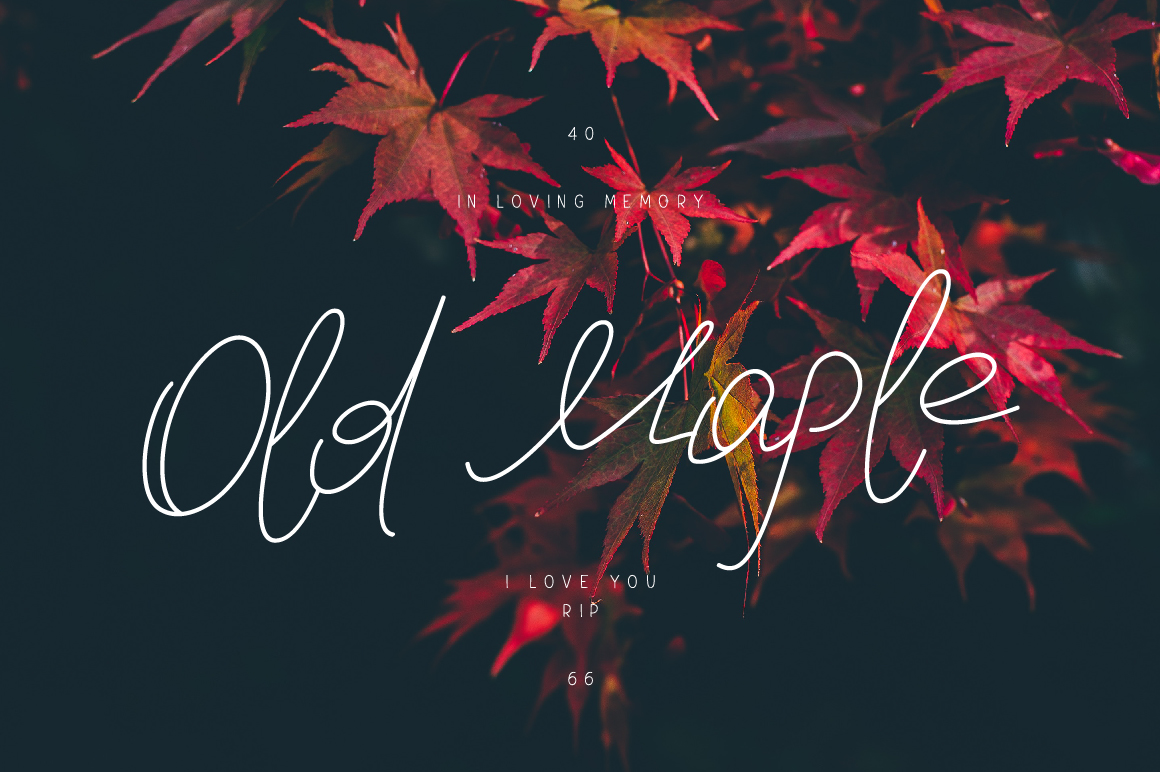
Typography has a way of preserving more than just letters. It captures moments, personalities, and even entire eras. That is exactly the story behind Old Maple, a font that didn't start in a design studio or a software interface, but in the worn pages of a father's notebook. Every glyph, from the familiar upright capitals to the flowing lowercase, carries the warmth and character of handwritten originals. The missing characters were not guessed at—they were carefully extrapolated from what already existed, ensuring the entire family of symbols feels cohesive, intentional, and alive.
At first glance, Old Maple might remind you of something nostalgic—a letter written by candlelight, a journal entry from decades past, or a sign painted by hand. But the font is not merely a relic. It is a fully realized typeface built for modern projects, complete with uppercase and lowercase letters, a comprehensive set of punctuation marks, numerals, ligatures, Cyrillic characters, and multilingual support. This article explores what makes Old Maple both a personal tribute and a practical tool for designers, writers, and typographers today.
From Handwritten Notes to Digital Typeface
Every typeface has a genesis story, and Old Maple's is particularly intimate. The designer took all the letters from a father's notebook—each character a unique artifact of his handwriting style. But what do you do when the notebook doesn't contain every letter of the alphabet? The answer is painstaking reconstruction. The missing letters were created based on the available ones, following the same stroke patterns, proportions, and quirks. This method ensures that the uppercase and lowercase sets feel like they belong to the same hand, even though they were digitally assembled.
This approach stands in contrast to generic handwriting fonts that often feel scattered or inconsistent. Old Maple manages to balance authenticity with legibility. The lowercase letters retain a natural flow, while the uppercase characters have a sturdy, almost architectural presence. The result is a typeface that feels personal without sacrificing usability. For anyone working on projects that require a touch of humanity—think branding for a coffee shop, a wedding invitation suite, or a personal blog—this font offers a sincere alternative to sterile sans-serifs.
The Craft Behind the Characters
One of the most impressive aspects of Old Maple is the sheer range of included characters. Beyond the basic 52 letters, the font features a broad set of punctuation marks that handle everything from standard American English to European punctuation conventions. Numerals are proportioned to sit comfortably alongside both uppercase and lowercase text, which is not always the case with handwriting-inspired fonts. Ligatures—those special combined glyphs for letter pairs like "fi", "fl", and "ff"—are also present, smoothing out awkward collisions and preserving the handwritten rhythm.
But what really elevates Old Maple is the Cyrillic support. Many personal or heritage fonts ignore non-Latin scripts, but this one includes a wide range of Cyrillic characters. That makes it a strong choice for multilingual projects, whether you are designing a bilingual brochure, a magazine spread, or a website header that needs to speak to audiences in Russian, Bulgarian, or Serbian. The Cyrillic glyphs were clearly constructed with the same logic as the Latin ones—the stroke weights, angle, and overall mood match beautifully.
What Makes Old Maple Stand Out in a Crowded Font Market
Typography enthusiasts know that handwriting fonts are a dime a dozen. What separates a good one from a great one is consistency and completeness. Old Maple ticks both boxes. The uppercase and lowercase letters share a unified baseline and x-height, which prevents that jarring shift in scale that plagues many vintage-inspired fonts. The ligatures aren't an afterthought—they are integrated so that words like "beautiful" or "difficult" read smoothly, without awkward gaps where letters almost touch.
Multilingual support is another differentiator. A font that handles only English is limiting in today's global design landscape. Old Maple's inclusion of Cyrillic and European diacritics (accents, umlauts, tildes) means you can typeset content for French, German, Polish, Turkish, and many other languages without switching typefaces. This is especially valuable for user interfaces, editorial layouts, or any project where language parity matters.
The numerals are worth a special mention. Handwritten digits can often look out of place—too large, too small, or styled differently from the letters. Old Maple's numerals are designed to sit comfortably in running text, aligning with both uppercase and lowercase contexts. Whether you're setting a price list, a date, or a telephone number, the numbers maintain the same authentic touch as the alphabet characters.
Built for Real-World Use: Where Does Old Maple Fit?
Designers often ask: "Is this font for display use or body text?" With Old Maple, the answer is not so black and white. The typeface works well at larger sizes for headlines, logos, and posters, where its handmade details can shine. The irregular stroke widths and subtle variations in letterforms give it a textured, organic look that mimics actual ink on paper. At smaller sizes, such as in a paragraph or a caption, it remains readable because the letters are relatively open and the contrast is moderate.
For branding projects, Old Maple exudes warmth and authenticity. Imagine a craft brewery label, a farm-to-table restaurant menu, or a boutique studio's identity. The font's roots in a personal notebook lend it a story—something clients and customers connect with emotionally. You can pair it with a clean sans-serif for contrast, or let it stand alone as the primary voice.
Publishing and editorial workflows also benefit from Old Maple's comprehensive character set. If you are laying out a literary magazine, a poetry collection, or an art catalog, the font adds a human touch without compromising on professionalism. The ligatures help maintain rhythm, and the punctuation includes all the standard quotes, dashes, and brackets needed for proper typesetting.
Practical Considerations Before Choosing Old Maple
When selecting a typeface, you want to know how it behaves in different environments. Old Maple is supplied as a standard digital font file (most likely OTF or TTF), which means it installs easily on both Windows and macOS. It works in Adobe Creative Suite, Figma, Word, and even Google Docs. Because it has a large glyph set, file size may be larger than a basic font, but that is a trade-off for the extensive language support.
Another factor is weight and style availability. As of this writing, Old Maple appears to be a single weight—it does not have multiple weights like Bold, Italic, or Light. That is typical for a handwriting-derived font, but it means you cannot create hierarchy solely through weight changes. Instead, rely on size, color, or pairing with a complementary typeface for emphasis. Use uppercase within sentences sparingly, as all-caps can feel overly loud with a handwritten font.
If you plan to use Old Maple for body text at very small sizes, test it first. Handwriting fonts generally have more stroke variation than geometric typefaces, which can affect legibility below 10 points. At 12–14 points, though, it reads beautifully, especially in short paragraphs or pull quotes.
Ligatures and Punctuation: Small Details That Matter
Ligatures in Old Maple are not just decorative—they solve real spacing issues. In handwriting, letters naturally connect, and when two characters like "f" and "i" are set side-by-side in a digital font, they can collide. The "fi" ligature replaces them with a single glyph where the dot of the "i" sits neatly above the arch of the "f". This same treatment applies to "fl" and "ff", ensuring that words look as they would if written by hand. The font also includes standard and discretionary ligatures, giving you control over how much connectedness you want.
Punctuation in Old Maple is designed to match the letterforms. Quotation marks are curved and friendly, dashes are en and em sized appropriately, and the ampersand is a standout character—elegant but not overly complex. For designers who care about detail, this level of thoughtful implementation means the font can be used in professional settings without looking amateurish.
Cyrillic and Multilingual Support: A Hidden Gem
Not every handwriting font goes the extra mile to include Cyrillic letters, but Old Maple does. For designers working on Eastern European markets, or for projects that need to combine Latin and Cyrillic text, this feature is a massive time-saver. You won't need to switch between fonts mid-sentence, which can cause mismatched aesthetics. The Cyrillic characters follow the same calligraphic principles, with similar stroke contrast and terminal shapes. This makes Old Maple a strong candidate for packaging, signage, and web design that targets Russian-speaking or Bulgarian-speaking audiences.
The multilingual support extends to Western European languages too. Accented characters like É, Ñ, Ü, and Ç are all present, so you can typeset French, Spanish, German, and Swedish without missing a beat. That coverage, combined with the Cyrillic set, means Old Maple is genuinely useful for global communication, not just a niche personal project.
Final Thoughts on Making Old Maple Work for You
Old Maple is more than a font—it is a bridge between generations. It carries the tactile memory of a father's handwriting into the digital age, preserving not just shapes but a sense of personality and care. For designers, that emotional resonance can make a project feel grounded and real. For writers, it offers a voice that is both familiar and distinctive.
When you consider adopting Old Maple, think about the story you want to tell. Use it for headlines that need warmth. Use it for short texts that benefit from a human touch. Pair it with a neutral sans-serif for contrast, or embrace its heritage by combining it with vintage textures and muted colors. The font's natural strength lies in its authenticity—so let it be the hero when you want to say something from the heart.
Whether you are labeling a handcrafted soap, designing a love letter-inspired wedding invite, or building a blog that feels like a handwritten journal, Old Maple delivers. Its uppercase and lowercase uniformity, deep character set, and multilingual readiness make it a practical choice that does not compromise on craft. Now all that is left is to let your own words live inside those beautiful, notebook-born letters.