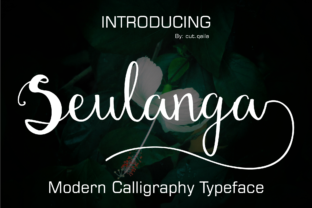
Seulanga: A Handwritten Calligraphic Font for Thoughtful Creative Work
When you browse font libraries or designer marketplaces, the sheer volume of typeface options can feel overwhelming. Among the many handwritten and script styles available, Seulanga stands out as an elegant calligraphic option that balances artistic flair with practical readability. It occupies a particular niche: refined enough for formal projects, yet organic enough to feel personal. If you are evaluating handwritten fonts for an upcoming project, understanding what Seulanga offers and where it fits best will help you decide whether it is the right choice.
What Makes Seulanga Distinct
Seulanga is a handwritten calligraphic-style font that draws on the fluid, expressive qualities of traditional brush or pen lettering. Unlike many script fonts that feel rigid or overly uniform, Seulanga retains a natural rhythm and variation in stroke weight that mimics real handwriting. This gives it a warmth and authenticity that clean digital fonts often lack.
One of its defining characteristics is the careful balance between elegance and legibility. Calligraphic fonts can sometimes sacrifice readability for flourish, but Seulanga keeps its letterforms clear enough for shorter blocks of text. The ascending and descending strokes are proportioned thoughtfully, making it suitable for headlines, invitations, and branding elements where you want the text to carry emotional weight.
Another distinct feature is the range of glyphs and stylistic alternates that come with the font. Depending on the version you use, you may have access to swashes, ligatures, and alternate characters that allow you to customize the look without switching typefaces. This flexibility is especially valuable when you need a consistent yet varied visual identity across different pieces.
Comparing Seulanga with Broader Font Categories
To understand where Seulanga fits, it helps to compare it with other categories of typefaces you might be considering. Handwritten calligraphic fonts like Seulanga occupy a middle ground between formal scripts and casual handwriting styles.
Versus formal script fonts. Traditional formal scripts, such as those inspired by copperplate or Spencerian penmanship, tend to have very precise, consistent strokes and often require careful kerning to look right. They can feel elegant but sometimes stiff. Seulanga offers a looser, more organic feel while still maintaining a level of refinement. If your project needs a sense of spontaneity or warmth, Seulanga may fit better than a strict formal script.
Versus casual handwriting fonts. At the other end of the spectrum, casual handwriting fonts can be irregular, uneven, or intentionally rough. These work well for informal contexts but may not suit projects where you need to convey sophistication or professionalism. Seulanga sits closer to the elegant side of handwritten fonts, making it a stronger candidate for invitations, logo concepts, or apparel designs where you want an approachable but polished look.
Versus serif and sans-serif fonts. Standard serif and sans-serif typefaces are workhorses for body text and long reading passages. They are designed for maximum readability at small sizes. Seulanga is not intended for lengthy paragraphs or dense text blocks. Its strength lies in display use, where the shapes and curves can be appreciated at larger sizes. If your project requires extended reading, a serif or sans-serif font will serve your audience better, but Seulanga can work beautifully for headings or short accent lines within that same design.
Strengths and Tradeoffs of Using Seulanga
Every typeface involves tradeoffs, and Seulanga is no exception. Understanding what it does well and where it has limitations will guide you toward the right application.
Strengths
- Visual appeal for display purposes. Seulanga shines when used at larger point sizes. Its calligraphic strokes become a design element in themselves, adding texture and emotion to headlines, quotes, or single words.
- Adaptability across project types. The font works well for logos, wedding or event invitations, product labels, apparel graphics, social media visuals, and packaging. Because it is not overly decorative, it can pair with a range of other typefaces and design styles.
- Customization options. With stylistic alternates and swashes, you can create variations within the same font family. This is useful when you need to maintain a cohesive look while avoiding repetition, especially in branding or invitation suites.
- Emotional resonance. Handwritten calligraphic fonts naturally convey a human touch. If your project aims to feel personal, artisanal, or heartfelt, Seulanga supports that intention without trying too hard.
Tradeoffs
- Limited readability at small sizes. Like most calligraphic scripts, Seulanga is not optimized for body text. At small sizes, the finer strokes can become thin and harder to read, especially on screens or in print with lower resolution.
- Not ideal for long-form content. Reading extended passages in a handwritten font can be tiring. Seulanga is best reserved for short bursts of text where each word carries weight.
- Pairing requires care. Because Seulanga has a strong personality, it needs a complementary font partner for other text elements. A neutral sans-serif or a classic serif often works, but finding the right balance takes some experimentation.
- May not suit all brand identities. If your brand voice is highly technical, corporate, or minimalist, a handwritten calligraphic font might feel mismatched. It tends to communicate creativity, tradition, or craftsmanship rather than efficiency or modernity.
Best-Fit Situations for Seulanga
Based on its strengths, certain types of projects are particularly well served by Seulanga.
For event invitations, such as weddings, galas, or milestone celebrations, Seulanga provides the elegance people often look for while keeping a warm, inviting tone. It works well on save-the-date cards, ceremony programs, and thank-you notes, especially when paired with a clean sans-serif for logistical details like dates and locations.
For branding and logos, particularly in creative fields, hospitality, or artisanal products, Seulanga can communicate a sense of handcrafted quality. A boutique bakery, a florist, a stationery shop, or a lifestyle blogger might find that Seulanga captures their visual identity more effectively than a standard script or serif logo.
For apparel and merchandise, calligraphic fonts are a popular choice because they work well on fabrics and can be embroidered or printed at various scales. Seulanga's flowing letterforms can make a t-shirt quote or a hoodie emblem feel distinctive without being illegible.
For social media graphics and quotes, where you typically have short text and room for visual impact, Seulanga helps your message stand out in a feed full of standard typefaces. Its organic feel can also help your content feel more authentic and less templated.
When Another Font Style Might Serve You Better
No single font works for every scenario. There are clear situations where Seulanga may not be the best choice, and recognizing these will save you time and frustration.
If your project involves heavy body text, such as articles, reports, or product descriptions, Seulanga is not suitable. Readers will struggle with extended passages, and the font's decorative qualities become a distraction rather than an asset. In these cases, a well-chosen serif or sans-serif font is essential, and you can still use Seulanga for headings or pull quotes if you want a touch of personality.
If you are designing for highly technical or corporate audiences, a handwritten calligraphic font may feel out of place. Industries like finance, law, engineering, or healthcare typically require a more neutral, professional appearance. A clean sans-serif or a classic serif communicates reliability and precision more effectively.
If your design requires multilingual support with extensive character sets, you should verify that the version of Seulanga you are considering includes the glyphs you need. Not all decorative fonts offer full coverage for languages beyond English or Western European scripts. This is an important practical check before committing.
If you need high legibility at very small sizes, such as on mobile interfaces, product labels with fine print, or business cards, Seulanga may become difficult to read. The thin strokes and calligraphic flourishes can compress poorly at small scales. In these contexts, a simpler, more geometric font will serve your users better.
Practical Considerations Before Choosing Seulanga
Before finalizing your font choice, there are a few practical factors worth evaluating. These apply to any handwritten or calligraphic typeface, but they are especially relevant for Seulanga given its stylistic nature.
Licensing and usage rights. If you are using Seulanga for commercial projects, check the license that comes with your purchase or download. Some font licenses restrict use in certain contexts, such as logo trademarking, merchandise resale, or embedding in apps. Make sure the license aligns with your intended use case.
File format and compatibility. Seulanga is available in common formats like OTF and TTF, which work across most design software. However, if you are working in a web environment, you may need a web font version or you may need to self-host the font files. Test the font in your specific tools before committing to a large project.
Pairing with other fonts. As mentioned earlier, Seulanga needs a complementary counterpart. A practical approach is to select a clean sans-serif such as a geometric or humanist style for body text and secondary information. Test a few pairings to see how the combination reads and whether the contrast is pleasing. Some designers find that a serif font with a similar x-height creates a more cohesive look.
Testing in context. Before finalizing your design, test Seulanga in the actual medium where it will appear. A font that looks beautiful on screen may behave differently in print, on fabric, or on a large sign. Print a sample, view it at different sizes, and consider how it will appear to your audience in the final format.
Making an Informed Decision About Your Font Choice
Choosing a font is not simply about aesthetics. It is about matching the typeface's characteristics to the goals of your project, the expectations of your audience, and the practical constraints of your medium. Seulanga offers a distinct combination of elegance, warmth, and flexibility that makes it a strong candidate for many creative projects, particularly those that benefit from a handwritten calligraphic touch.
However, it is not a universal solution. The same qualities that make it appealing for a wedding invitation or a boutique logo can become limitations in a corporate report or a mobile app. By understanding where Seulanga excels and where it falls short, you can make a more confident decision that serves both your design vision and your audience's experience.
If your project calls for a font that feels personal, refined, and handcrafted without being overly ornate, Seulanga is worth exploring. If you need something more neutral, more readable at small sizes, or more suited to long-form content, you may want to consider other options while perhaps using Seulanga as an accent. The best choice is the one that aligns with your specific context, and being thoughtful about that alignment is what separates a good design from a great one.