Justin Brush: A Handcrafted Calligraphy Font for Authentic Design
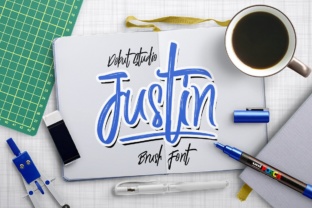
When you need a typeface that feels genuinely hand‑made, few options capture the spontaneous energy of real brush lettering like Justin Brush. This handwritten calligraphy‑style font is created entirely by hand using a brush pen, resulting in strokes that vary in pressure, angle, and flow. Unlike many script fonts that rely on mathematical curves or repeated shapes, Justin Brush carries the subtle imperfections of a real hand—slight ink bleeds, uneven tapers, and natural rhythm. This article explores what makes Justin Brush distinct, how it compares with other handwritten and calligraphy fonts, and when it might be the right choice for your project.
What Makes Justin Brush Different?
Justin Brush belongs to a category of fonts that prioritize authenticity over perfection. Every letterform is the result of a physical brush pen moving across paper, then digitized without heavy smoothing. The result is a typeface that feels personal, immediate, and organic. Common characteristics include:
- Pressure variation – Thick downstrokes and thinner upstrokes, typical of brush lettering, but with more irregularity than a controlled nib pen.
- Natural unevenness – Baseline shifts and slight inconsistencies in letter spacing that mimic hand‑lettering.
- Texture – Subtle roughness at stroke edges, giving a tactile quality even on screen.
This combination sets Justin Brush apart from cleaner script fonts (e.g., those inspired by copperplate or Spencerian styles) and from vector‑based brush fonts that auto‑smooth irregularities. It also differs from dry brush or grunge fonts that emphasize extreme texture—Justin Brush retains a readable, friendly character while still feeling handcrafted.
Comparing Justin Brush with Other Handwritten and Calligraphy Fonts
When evaluating a font like Justin Brush, it helps to consider the broader landscape of handwritten and calligraphy typefaces. Decisions often hinge on the level of formality, the intended scale, and the medium (print vs. screen).
Versus Polished Script Fonts
Polished script fonts (such as those based on formal penmanship) offer uniform slant, consistent stroke widths, and predictable spacing. They work well for elegant invitations, formal logos, or any context where precision conveys luxury. Justin Brush, by contrast, leans into the casual, approachable side of calligraphy. It is better suited for friendly branding, craft products, or personal projects where you want to emphasize the human touch over perfection.
Versus Other Handwritten Fonts
Many handwritten fonts are made from digital drawing tablets or styluses, which can result in smoother curves and less texture. Justin Brush—being an actual brush pen creation—tends to have more expressive upstrokes and a broader dynamic range. It also avoids the overly consistent “digital look” that some users feel is too clean. However, that same expressiveness can make it less predictable: some letters may appear heavier or lighter than expected, which can be a tradeoff in readability.
Versus Dry Brush or Grunge Fonts
Dry brush fonts deliberately create fragmented, distressed strokes for a rough, edgy feel. Justin Brush is not distressed—it preserves a clean (though organic) stroke. This makes it more versatile for applications that need a handcrafted feel without appearing worn or damaged.
Strengths of Justin Brush
Understanding where Justin Brush excels helps you decide if it fits your project’s tone and technical requirements.
- Authentic character – Projects that aim for sincerity, warmth, or creativity benefit from a font that looks and feels hand‑done. Justin Brush works especially well for small businesses, artisan brands, wedding stationery, and social media graphics.
- Visual hierarchy – As a display font for headings, quotes, or short bursts of text, its dynamic strokes draw attention and add personality without needing extra ornamentation.
- Compatibility with simple layouts – Paired with a clean sans‑serif or neutral body font, Justin Brush creates contrast that feels intentional and modern.
- Versatility across contexts – While best at larger sizes, it also works for short phrases in print (e.g., product packaging, greeting cards) where a machine‑made look would feel impersonal.
Tradeoffs and Limitations
No single typeface is ideal for every situation. Justin Brush has limitations that you should weigh carefully.
- Small‑size readability – The same natural variations that give it charm can make it difficult to read at very small sizes (under 12pt on screen, under 8pt in print). Ascenders and descenders may clash, and the irregular spacing can slow reading.
- Limited character set – Some handwritten fonts include only basic Latin characters and a few ligatures. Check that Justin Brush covers the glyphs you need (accents, punctuation, numbers) before committing.
- Inconsistency across letters – Designers who prefer strict uniformity may find the varying stroke weights and occasional swashes distracting. This is not a font for corporate reports or dense body text.
- Ligature and alternate dependency – Many brush fonts rely on OpenType features (ligatures, stylistic alternates) to avoid repetitive letterforms. Ensure your design software supports these features—otherwise common letter pairs might look awkward.
When Justin Brush Is the Right Choice
Consider Justin Brush when the primary goal is to convey personality and a human touch. Ideal scenarios include:
- Branding for creative professionals, boutiques, coffee shops, or lifestyle bloggers.
- Invitations, save‑the‑dates, or event materials that should feel personal and artisanal.
- Header text for websites, email newsletters, or social media posts where you want to break away from typical sans‑serifs.
- Product labels, packaging, or signage where the material (e.g., kraft paper, matte finish) complements the handcrafted style.
When an Alternative Might Be Better
If your project demands high legibility at small sizes, or if you need a font that works for long‑form text, you should look for a more neutral option. Similarly, if you require a very formal or corporate tone, a classic serif or a polished script may be more appropriate. For the web, consider that highly decorative fonts can slow loading if they contain many glyphs, so check file sizes and rendering on different devices.
Another consideration is language support. If your audience uses accents or non‑Latin scripts, verify that Justin Brush covers those. Most brush fonts are designed initially for English, so you may need to supplement with a companion font or choose a more comprehensive alternative.
Decision Factors for Choosing Justin Brush
To help you evaluate, here are the key factors to weigh:
- Project tone – Friendly, creative, casual → strong match. Professional, formal, minimal → likely mismatch.
- Scale and medium – Larger sizes (headings, posters, logos) → works well. Small text or long paragraphs → look for a more legible alternative.
- Pairing potential – Can you find a simple sans‑serif or serif to accompany it? If yes, Justin Brush can act as an accent. If you need a one‑font solution, its limitations become more significant.
- Technical requirements – OpenType support, glyph coverage, file format (web vs. print). Test the font in your specific workflow before finalizing.
- Audience expectation – Does your audience value uniqueness and craft? Or do they expect clarity and uniformity? Matching the font to user expectations avoids miscommunication.
Practical Examples of Use
Imagine you are designing a logo for a hand‑poured candle maker. The brand depends on warmth and natural materials. Justin Brush in the logo paired with a light, geometric sans‑serif for the tagline creates a contrast that feels both artisanal and trustworthy. For the product labels, using Justin Brush at a moderate size (18–24pt) for the scent name and a small clean font for ingredients works well. Avoid using it for the ingredient list itself—that would be illegible.
Alternatively, for a wedding website, using Justin Brush for the couple’s names and section headings (Our Story, Gallery) while setting body text in a readable serif like Lora or Georgia keeps the design cohesive without sacrificing readability on mobile.
In contrast, if you were designing a legal invoice template, Justin Brush would be wholly inappropriate. The informal character would undermine trust, and the irregular spacing could confuse numbers and details. A clean sans‑serif like Inter or Roboto would serve better.
Making an Informed Decision
Justin Brush is a distinctive tool in your typeface toolbox, not a one‑size‑fits‑all solution. Its strength lies in its ability to inject personality and the illusion of handcraft into your work. When used deliberately—at the right size, for the right audience, with a suitable companion font—it can elevate design projects that crave authenticity. When misapplied, it can hinder readability and feel out of place.
Take the time to test Justin Brush in your actual layouts: at various sizes, on screen and in print, and with the specific content you plan to use. Compare it with a few other handwritten or calligraphy options to see which one aligns best with your project’s goals. The best font choice is the one that feels invisible to your audience—it supports your message without drawing attention to itself.
Whether Justin Brush becomes your go‑to for creative projects or a specialty option for specific uses, understanding its character, tradeoffs, and best‑fit scenarios will help you make a confident, user‑focused choice.