Nathain: The Hand-Brushed Font That Brings Authenticity to Digital Design
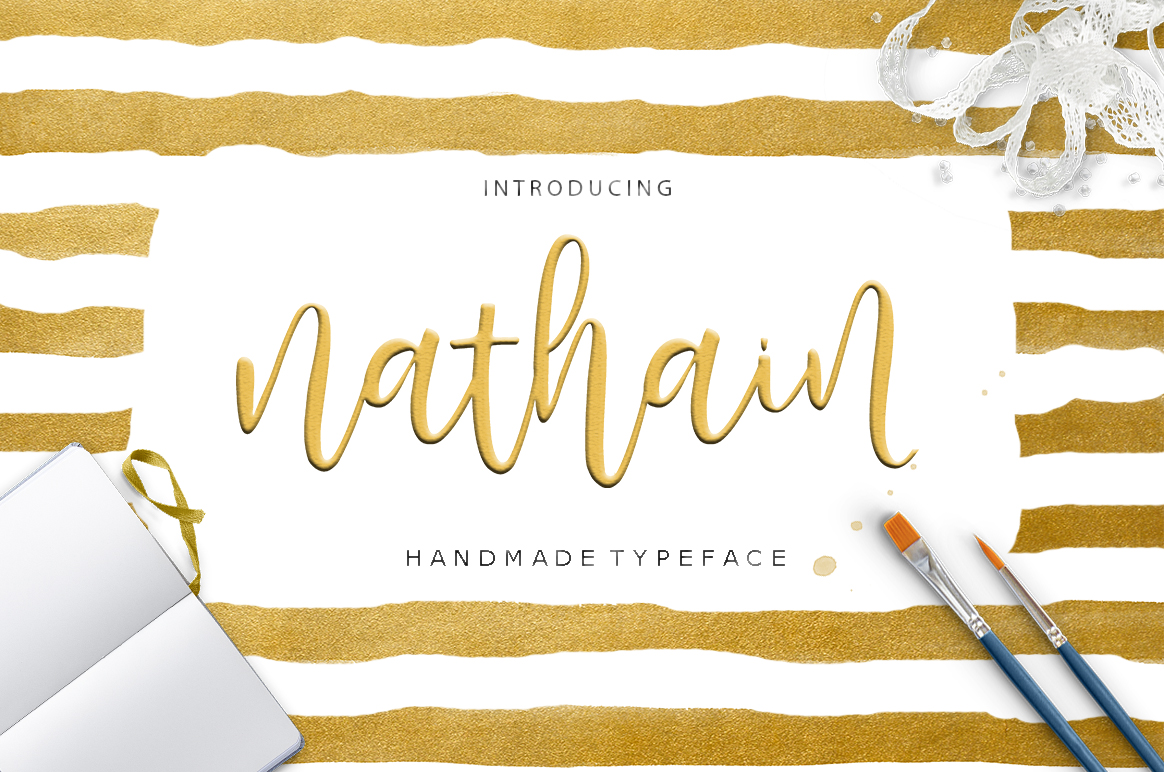
Typography has long been a bridge between intention and interpretation. For years, the push has been toward precision—perfectly aligned letters, uniform strokes, and mathematically spaced characters. But as digital spaces become more crowded, something interesting is happening. Audiences are craving the opposite. They want texture, imperfection, and a tangible sense of human touch. That is exactly where Nathain enters the conversation. This hand-brushed font, created with actual brush and ink on paper, brings a raw, organic quality that most digital typefaces cannot replicate. Its irregular baseline—where letters dip and rise naturally—makes text feel alive, as if it was written in real time. For designers, business owners, and creators looking to stand out, Nathain offers a way to inject personality into screens without losing readability.
Why a Hand-Brushed Font Matters Now
We are in an era where automation dominates. AI-generated text, templated designs, and stock imagery are everywhere. Consumers have become adept at spotting what feels mass-produced. In response, brands and creators are rediscovering the value of authenticity. A hand-brushed font like Nathain signals effort and care. It says someone sat down with a brush and ink, made deliberate strokes, and let the imperfections remain. This resonates with modern audiences who are tired of polished surfaces and want to connect with something real.
Current trends in branding and web design reflect this shift. "Human-centered design" is no longer just a buzzword; it influences decisions from color palettes to typography. Organic shapes, tactile textures, and hand-drawn elements are being used to soften the rigid digital landscape. Fonts with irregular baselines fit perfectly into this movement because they break the monotony of perfectly aligned text. Nathain, with its natural flow up and down, mimics the rhythm of handwriting. This makes it especially effective for hero headers, pull quotes, or any place where you want the viewer to pause and feel something.
Moreover, the rise of remote work and independent creators has democratized design. Freelancers, solopreneurs, and small teams no longer need expensive branding packages to project a unique identity. A single thoughtful typeface choice can set the tone. Nathain offers a way to achieve that distinctiveness without sacrificing legibility—a balance that many script or brush fonts struggle to maintain.
The Evolution of Typography: From Perfect to Personal
Typography did not always chase perfection. Early movable type had irregularities baked into the process—ink spread, pressure varied, and letters often leaned slightly. But as printing technology advanced, so did the push for uniformity. The 20th century gave us Helvetica, Futura, and other geometric sans-serifs that became the gold standard for clarity. Then the digital age arrived, and suddenly every designer could access thousands of fonts that were essentially perfect in their rendering. Yet something was lost.
In the last decade, a counter-movement emerged. Designers began seeking out typefaces that felt lived in. Brushed scripts, hand-lettered styles, and distressed fonts gained popularity in packaging, editorial design, and even user interfaces. Nathain belongs to this lineage but brings something distinct: it was not digitized from a computer-drawn curve but from actual brush-on-paper strokes. The ink bled, the pressure varied, and the baseline wobbled. These quirks were preserved in the digital file, meaning every character carries the memory of its physical creation.
This evolution is not just aesthetic; it reflects how people work and consume content. With shorter attention spans, a memorable visual hook is crucial. A font that moves unpredictably captures the eye faster than one that sits perfectly still. It signals that the content beneath it is worth engaging with—perhaps because it is personal, opinionated, or crafted with care. Nathain fits that role naturally because it does not look like it was assembled by a machine.
Practical Implications for Creators and Professionals
Using Nathain effectively requires understanding where its strengths lie. Because of its irregular baseline, it works best when applied sparingly and with intention. A full body of text set in Nathain would be exhausting to read, but a headline, a logo, or a featured quote can become instantly iconic.
- Branding: Small businesses and boutique brands can use Nathain to convey artisanal quality. A coffee shop, a handmade soap company, or a creative consultancy could feature it on signage, packaging mockups, or website hero sections. The baseline variations add warmth and approachability.
- Web design: Modern landing pages often use a mix of a decorative display font for the headline and a clean sans-serif for body text. Nathain plays the part of the expressive headline beautifully. It can also be used for call-to-action buttons or section dividers to create visual rhythm.
- Social media: In a feed full of polished graphics, a post with Nathain lettering stands out. It works well for motivational quotes, announcements, or any content that benefits from a handcrafted feel. Instagram stories, Pinterest pins, and LinkedIn banners can all benefit from its organic movement.
- Video and motion: The irregular baseline becomes even more dynamic in animation. When letters shift up and down slightly over time, it mimics the natural motion of handwriting. This is especially effective for title sequences, lower thirds, or end screens.
Another practical consideration is pairing. Nathain pairs well with simple, neutral typefaces that provide contrast. A light sans-serif like Open Sans or Lato lets Nathain take center stage without clashing. Avoid pairing it with other decorative or script fonts, as the visual noise can confuse the viewer. The goal is to let the hand-brushed quality shine as the accent.
Why Irregular Baselines Are a Feature, Not a Flaw
Some designers might initially view an irregular baseline as a limitation. In conventional typography, even baselines are considered essential for readability. But that assumption is rooted in print standards that do not always translate to digital behavior. On screens, users scroll and scan; they do not read every letter in sequence. A font that moves up and down can actually aid scanning by breaking the monotony of rows. It creates a visual pulse that draws the eye along the line.
Nathain embraces this irregularity as a core strength. It rejects the idea that type must be perfectly horizontal to be legible. Instead, it trusts the reader to follow the natural flow—much like how we read handwritten notes without demanding strict alignment. This makes the font especially suitable for short-form, high-impact contexts where emotional resonance matters more than reading speed. Think of a restaurant menu, a personal brand logo, or a poster for a creative event. In each case, the font's personality is part of the message.
Furthermore, irregular baselines align with the broader shift toward inclusive and accessible design—not in the technical accessibility sense, but in emotional accessibility. A font that does not feel rigid or intimidating invites a wider range of responses. It can feel playful, sincere, or even rebellious. Nathain's brush origins add a tactile layer that digital-only fonts lack, reminding viewers that there is a human hand behind the screen.
Realistic Examples and Observations
Consider an online boutique selling hand-dyed textiles. Their current website uses a standard sans-serif throughout. They want to convey the handmade nature of their products. By introducing Nathain in the site header, product category titles, and limited-edition badges, they instantly communicate craftsmanship. The irregular baseline mirrors the slight variations in their dyeing process. Customers drawn to handmade goods often respond positively to such cues because they reinforce the brand's story.
Another example: a freelance copywriter updating their portfolio. They use Nathain for their name and tagline at the top of the page. Below that, a clean serif font carries the body text. The contrast signals creativity and professionalism simultaneously. Potential clients scanning the page will notice the hand-lettered name first, then dig into the details. The font becomes a subtle trust signal.
Observations from current design trends show that brands are moving away from sterile perfection toward something more candid. "Authentic" has become a overused word in marketing, but fonts like Nathain give it tangible form. When a brand actually uses a typeface drawn by hand, the claim of being handmade or artisanal gains credibility. It is no longer just a tagline; it is visible in every letter.
That said, Nathain is not a magic solution. It works best when the overall design remains clean and uncluttered. If paired with too many competing textures, patterns, or colors, the font's charm can be lost. Restraint is key. Use it where you want the eyes to rest—headlines, single word calls-to-action, or accent phrases. Overusing it dilutes the effect.
Recommendations for Getting Started
If you are considering adding Nathain to your design toolkit, here are a few grounded suggestions:
- Test readability at different sizes. The irregular baseline becomes more pronounced at larger sizes, which is usually where you want it. At smaller sizes (below 24px in web contexts), readability may drop. Reserve it for display purposes.
- Use it in high-contrast scenarios. Dark text on a light background, or light text on a dark image, will make the brush strokes pop. Avoid busy backgrounds that compete with the font's texture.
- Pair with a stable body font. A clean, neutral sans-serif (like Inter, Rubik, or Work Sans) creates a visual anchor. Let Nathain be the expressive element while the body font provides reading comfort.
- Consider medium and format. Nathain works beautifully in print (packaging, posters, business cards) and digital (web headers, social graphics, video titles). But its impact is strongest when used intentionally, not as a default.
- Embrace the irregularities. Do not try to force it into a rigid grid. Allow the letters to breathe. In layouts, give extra margin space so the font's movement feels natural rather than cropped.
The Role of Handcrafted Fonts in Modern Workflows
For professionals, using a font like Nathain also reflects a broader workflow shift. Templates and automated design tools have lowered the barrier to entry, but they also create homogeneity. The professionals who differentiate themselves are those who inject handcrafted elements into their deliverables. A custom hand-brushed font used in a client presentation or digital product shows a level of detail that is becoming rare. It suggests that the creator went beyond drag-and-drop to produce something uniquely fitting.
Freelancers and entrepreneurs can leverage this to charge premium rates. A brand identity that includes a bespoke hand-lettered typeface—even a single display font like Nathain—elevates the perceived value. It signals that the work is not just designed, but crafted. In a competitive market, that distinction matters.
Moreover, the digital tools we use today make it easier than ever to incorporate such fonts. Most website builders, design software, and content management systems support custom font uploads. A single CSS @font-face rule can bring Nathain into a web project. The barrier is not technical; it is conceptual. The question is whether you are willing to let typography carry emotion.
Final Thoughts
Nathain is more than a font. It is a conversation starter about what we value in design. In a world where so much communication is automated and uniform, a hand-brushed typeface with an irregular baseline stands as a quiet rebellion. It reminds us that imperfection is not a flaw to be corrected, but a quality to be celebrated. For anyone looking to make their work feel more human—whether you run a blog, a business, or a creative studio—Nathain offers a simple yet powerful way to reconnect with the audience. Use it with purpose, and your text will not just be read; it will be felt.