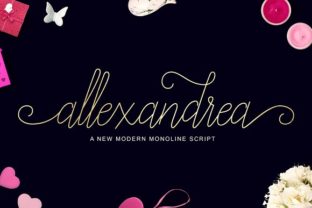
Allexandrea Font Review: A Monoline Typeface with a Bouncy, Irregular Baseline
When evaluating display typefaces for branding, packaging, or digital media, the choice often comes down to how a font communicates tone without overwhelming the message. Allexandrea is a monoline script font distinguished by its deliberately irregular baseline, which creates a bouncy, hand-drawn rhythm. This article provides a practical evaluation of Allexandrea, exploring its strengths, limitations, and the scenarios where it either excels or falls short. The goal is to help you determine whether this typeface aligns with your specific design goals and workflow requirements.
What Is Allexandrea?
Allexandrea is a monoline script typeface, meaning that its strokes maintain a consistent thickness throughout each character. This uniformity is characteristic of many modern script fonts, but what sets Allexandrea apart is its intentionally uneven baseline. Instead of resting on a perfectly flat line, letters in Allexandrea rise and fall slightly, mimicking the natural variation of handwriting or the playful bounce of hand-lettered signage.
The font includes uppercase and lowercase characters, numerals, and a selection of punctuation and ligatures. Its design leans toward a casual, friendly aesthetic rather than a formal or rigid structure. The irregular baseline is not a flaw but a core feature that defines the font's personality and informs how it should be used in real projects.
Why Designers Consider Allexandrea
Designers typically evaluate Allexandrea for projects where a human, approachable, or whimsical tone is desired. The monoline construction ensures that even at smaller sizes, the text remains legible and clean, while the uneven baseline adds visual interest that can make headings and short phrases feel more dynamic.
Several practical reasons explain why Allexandrea appears on many shortlists:
- Consistent stroke weight simplifies scaling across different media, from business cards to large-format banners.
- The irregular baseline creates a sense of movement that static, perfectly aligned fonts cannot achieve.
- It works well for short-form content where you want the typeface itself to contribute to the mood of the design.
- Ligatures and alternate characters give you flexibility to adjust the flow and avoid repetitive letter combinations.
These characteristics make Allexandrea a candidate for projects that prioritize personality over strict uniformity. However, as with any distinctive typeface, the same qualities that make it appealing in one context can become liabilities in another.
Benefits of Using Allexandrea
When Allexandrea is a strong fit, it delivers several tangible benefits that can enhance a design's effectiveness.
1. Visual Rhythm and Human Touch
The bouncy baseline is Allexandrea's most distinguishing feature. It creates a natural reading rhythm that feels less mechanical than many script fonts. For brands or messages that want to convey warmth, creativity, or a handcrafted feel, this irregularity is an asset rather than a distraction. It can soften the perceived formality of a layout and make content feel more conversational.
2. Legibility at Display Sizes
Monoline scripts often struggle with legibility at smaller point sizes because the consistent stroke width can cause letters to blend together. Allexandrea manages this reasonably well due to its relatively open letterforms and generous spacing. For headlines, subheadings, and short paragraphs (three to five words), it remains clear and readable even when scaled down to around 18–24 points, depending on the medium.
3. Versatility Across Color and Background
Because the stroke width is uniform and the letters have moderate contrast against most backgrounds, Allexandrea performs well in both light-on-dark and dark-on-light applications. You can pair it with solid colors, gradients, or photographic backgrounds without losing the font's character. This makes it suitable for social media graphics, product labels, and event posters where background variation is common.
4. Good for Branding That Needs a Personal Touch
Small businesses, creative professionals, and lifestyle brands often choose Allexandrea for logos and wordmarks. The bouncy baseline suggests individuality and approachability, which can help a brand feel less corporate and more relatable. When combined with a clean sans-serif for body text, Allexandrea can anchor a visual identity that feels both playful and professional.
Tradeoffs and Practical Considerations
No typeface is universally suitable, and Allexandrea has constraints that designers must weigh carefully before committing to it in a project.
1. Limited Suitability for Long-Form Text
The irregular baseline that gives Allexandrea its charm becomes a readability challenge in longer passages. As the eye moves across multiple lines, the uneven letter heights create a visual inconsistency that can cause fatigue. For body copy, paragraphs, or any text exceeding two or three lines, an alternative typeface with a stable baseline will almost always be more appropriate. Allexandrea is best reserved for display or accent usage where the bounce is an intentional design element rather than a distraction.
2. Pairing Complexity
Finding complementary typefaces for a font as distinctive as Allexandrea requires deliberate effort. Because the irregular baseline is so prominent, pairing it with another script or a highly decorative font can result in visual chaos. Most designers find that a neutral sans-serif with moderate weight and simple letterforms works best as a secondary typeface. This pairing dynamic adds a layer of decision-making that simpler, more neutral fonts do not require.
3. Licensing and File Format Considerations
Before purchasing, verify which file formats are included (OTF, TTF, WOFF, WOFF2) and whether the license covers your intended use cases—commercial projects, web embedding, app integration, or print. Some font licenses restrict the number of users or installations, which matters for teams or agencies. If you plan to use Allexandrea across multiple client projects, confirm that the license allows for such distribution. Overlooking licensing details can lead to unexpected costs or legal issues later.
4. Not Ideal for Formal or Conservative Contexts
If your project demands a professional, authoritative, or traditional tone, Allexandrea will likely work against that goal. Its playful baseline and casual script style can undermine the gravity of legal documents, financial reports, medical communications, or luxury branding that relies on restrained elegance. In these scenarios, a more conventional serif or sans-serif with a consistent baseline is a safer choice.
When Allexandrea Is a Strong Fit
Understanding the contexts where Allexandrea performs best helps you decide whether to include it in your typeface library for a given project.
- Small business branding: Coffee shops, bakeries, florists, boutiques, and creative studios often benefit from a friendly, handcrafted look.
- Event materials: Wedding invitations, birthday party flyers, art show posters, and holiday cards can use Allexandrea's bounce to convey celebration and informality.
- Social media visuals: Short quotes, promotional banners, and Instagram story titles gain personality without sacrificing quick readability.
- Product labels: Handmade goods, organic products, and artisan items can use Allexandrea to emphasize craftsmanship and individuality.
- Children's content: Book covers, apps, and educational materials aimed at younger audiences benefit from the font's energetic and friendly appearance.
In each of these cases, the font's irregular baseline reinforces the intended message rather than competing with it. The key is to use Allexandrea sparingly and strategically as an accent or headline font, not as a workhorse for extended reading.
When Alternatives May Be Worth Considering
There are several scenarios where even though Allexandrea seems appealing on the surface, an alternative typeface might better serve your goals.
1. Body Text and Long-Form Copy
If your project involves paragraphs, articles, or product descriptions longer than a few lines, choose a typeface with a stable baseline designed for extended reading. Open-source options like Lato, Open Sans, or Merriweather provide neutral, highly legible foundations. Allexandrea can still appear in headings, but it should not carry the burden of body text.
2. Multilingual or Special Character Requirements
Before committing, check whether Allexandrea supports the character set you need. Some script fonts have limited language support, which can be a problem if your audience includes speakers of languages with diacritics or non-Latin scripts. If broad language coverage is essential, a more comprehensive typeface will save you time and ensure consistency.
3. Strict Brand Guidelines
Organizations with rigid brand standards may require consistent vertical alignment across all typography. Allexandrea's irregular baseline means that letters will not align perfectly across a grid, which can conflict with systems that demand precise typographic harmony. In such environments, a geometric sans-serif or a traditional serif with a stable baseline will integrate more smoothly.
4. Low-Resolution or Small-Scale Displays
On screens with low pixel density or at very small point sizes, the subtle details of Allexandrea's baseline variation can become indistinct, making the text look messy rather than charming. If your primary output is mobile devices with small screens or low-resolution digital signs, test the font at actual size before making a final decision. You may find that a simpler script or a clean sans-serif performs better under those constraints.
Practical Decision-Making Insights
Choosing whether to use Allexandrea comes down to aligning the font's inherent characteristics with the practical demands of your project. Here are some actionable guidelines to support your evaluation.
Evaluate the Role of Typography in Your Design
Ask yourself: Is the typeface meant to be a supporting element or a central visual feature? If the typography needs to recede and let imagery or content take center stage, Allexandrea's distinctive baseline may draw too much attention. If the type itself is part of the visual story, the font's personality becomes a strength.
Test in Context
Always test Allexandrea in your actual layout with your specific content before making a purchase or committing to a design direction. A font that looks appealing in a specimen sheet can behave differently when paired with a specific logo, color palette, or background image. Test at the actual sizes and resolutions you will use, and view it on multiple devices if digital output is involved.
Plan for Pairing Early
Identify a complementary secondary typeface early in the design process. A simple, neutral sans-serif such as Montserrat, Nunito, or Poppins often works well alongside Allexandrea. Establish hierarchy rules—use the sans-serif for body text, captions, and navigation, and reserve Allexandrea for headings, logos, and emphasis. This prevents the layout from feeling disjointed.
Weight the Emotional Impact
Fonts carry emotional weight. Allexandrea communicates approachability, creativity, and a casual tone. If that emotional valence aligns with your brand voice or message, the font is a logical choice. If you need to convey authority, precision, or restraint, look elsewhere. Being honest about the emotional requirements of your project will save you from forcing a mismatch.
Final Thoughts on Evaluating Allexandrea
Allexandrea is a well-executed monoline script that succeeds in delivering a bouncy, human feel without sacrificing legibility at display sizes. Its irregular baseline is both its greatest asset and its most significant constraint. For projects where personality, warmth, and a handcrafted aesthetic are central, Allexandrea can be an excellent choice. For body text, formal branding, or situations requiring strict typographic consistency, it is less suitable.
By understanding the specific contexts where Allexandrea shines and where it struggles, you can make an informed decision that serves your design objectives rather than working against them. Test it, pair it thoughtfully, and always prioritize the reader's experience over the font's novelty. When used with intention, Allexandrea adds a distinctive voice to your typographic toolkit.