Merysha: A Classical Serif Font Built for Readability and Elegance
When you are searching for a typeface that carries both charm and discipline, the options can feel surprisingly narrow. Many serif fonts lean either toward rigid formality or decorative excess, leaving you to compromise between visual appeal and practical use. Merysha manages to sidestep that dilemma entirely. This classical looking serif font brings together the best of traditional type design with the kind of clarity and versatility that modern projects demand. Whether you are laying out a book, designing a brand identity, or crafting a website, Merysha offers a refined solution that works across multiple contexts without losing its character.
What Makes a Serif Font Truly Readable?
Readability in a serif font is not just about letter shapes. It is about how those shapes interact with each other at different sizes and on different surfaces. Merysha has been designed with careful attention to spacing, stroke contrast, and x-height, all of which contribute to a smooth reading experience. The letterforms are clear without being clinical. There is a gentle rhythm to the way the characters sit next to each other, which reduces eye strain during longer reading sessions. This is especially important for body text, where the font must remain unobtrusive while still guiding the reader forward.
Many serif fonts that look beautiful in headlines become tiring in paragraphs. The proportions shift, the serifs feel heavy, and the overall texture becomes uneven. Merysha avoids this because its design priorities are balanced from the start. The stroke weights are consistent, the apertures are open enough to keep letters distinguishable even at small sizes, and the serifs themselves are refined rather than bulky. This makes it a strong candidate for editorial work, long-form content, and any situation where the text needs to be both elegant and effortless to read.
The Role of Decorative Embellishments in a Functional Font
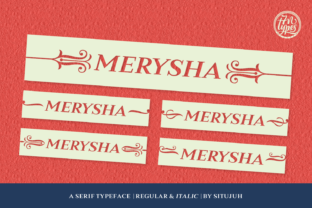
One of the most distinctive features of Merysha is that it comes with decorative embellishments that match the font perfectly. This is not an afterthought or a random collection of flourishes. The embellishments are designed with the same attention to proportion and style as the core letterforms. They include swashes, ligatures, and ornamental elements that can be used to enhance titles, drop caps, or section breaks without looking forced or out of place.
What makes these embellishments genuinely useful is that they integrate naturally with the rest of the typeface. You do not have to struggle to make them fit. They are not overly ornate or distracting. Instead, they add a layer of sophistication that elevates the overall design. For instance, in a wedding invitation or a formal brand booklet, a well-placed swash can turn a simple headline into something memorable. In a magazine layout, ornamental elements can serve as subtle dividers or accents that reinforce the visual identity without overwhelming the content.
It is worth noting that not every project needs decorative flourishes. But having them available as part of the same font family means you can use them sparingly and intentionally. That restraint is part of what makes Merysha such a flexible choice. You are not locked into a decorative style. You can choose when and where to apply the embellishments based on the tone and purpose of your project.
Versatility Across Formats: Titles, Headlines, and Body Text
Versatility in a typeface often comes with trade-offs. A font that works well for headlines may lack the subtlety needed for body text. A font that reads smoothly in paragraphs may not have enough presence for display use. Merysha manages to cover both ends of that spectrum without compromising on either. This is partly due to its classical proportions, which give it a dignified appearance at larger sizes while retaining clarity at smaller ones.
When used as a headline, Merysha commands attention. The serifs have enough weight to anchor the letters, and the overall shape of each character feels substantial. It works well for chapter titles, hero sections, and brand names. The decorative embellishments can be introduced at this level to add flair, but even without them, the font holds its own.
As body text, Merysha performs with a quiet confidence. The line height can be adjusted to suit different column widths, and the font maintains its readability across various screen resolutions and print finishes. This dual functionality means you can use Merysha as the sole typeface for an entire project, which simplifies your workflow and creates a cohesive visual language. Instead of juggling multiple fonts and worrying about compatibility, you get a single solution that adapts to each context naturally.
Practical Benefits for Designers and Content Creators
From a workflow perspective, Merysha saves time. Having a font that works across all your headings and body copy reduces the number of decisions you need to make during the design process. You do not have to test multiple pairings or worry about contrast between different typefaces. The font itself provides enough variety through its weights, styles, and decorative options to keep the layout interesting without introducing inconsistency.
For print projects, Merysha behaves well in both digital and offset printing. The stroke contrast is moderate enough that thin lines do not disappear at small sizes, and the serifs remain crisp even on uncoated paper. This makes it a reliable choice for books, brochures, stationery, and packaging. In digital environments, the font renders smoothly across browsers and operating systems, which is a consideration that matters more now than ever.
Another practical benefit is the font's ability to convey a certain tone without shouting. Merysha is classical but not old-fashioned. It has a contemporary polish that keeps it relevant for modern branding and editorial design. If you are working on a project that needs to feel established, trustworthy, and refined, this typeface immediately contributes to that impression. It is particularly well suited for industries like publishing, hospitality, luxury goods, law, and education, where credibility and elegance are essential.
What to Consider Before Choosing Merysha
As with any typeface, there are factors worth considering before committing to it for a project. First, think about the volume of text you will be setting. For very long documents or dense technical content, you may want to test Merysha at your intended size and line spacing to confirm it meets your comfort standards. While it is designed for readability, every typeface performs differently depending on the medium and the reader's environment.
Second, consider the decorative embellishments and how they fit into your overall design system. They are an asset, but they should be used with intention. Overusing swashes and ornaments can quickly make a design feel cluttered or overly ornate. The best approach is to treat them as accents rather than default elements. Reserve them for key moments in your layout, such as chapter openings, pull quotes, or special sections where you want to draw attention.
Third, evaluate the licensing and format options available for Merysha. Depending on where you plan to use it, you may need different file formats or licensing terms. For web use, make sure the font includes appropriate web font formats like WOFF and WOFF2. For desktop use in design software, OTF or TTF formats are standard. Checking these details ahead of time prevents compatibility issues later in the production process.
Finally, consider the emotional tone of your project. Merysha carries a sense of tradition and care. It is not a casual or playful font. If your brand or content calls for something more modern, minimalist, or informal, this may not be the ideal match. But if you are aiming for warmth, authority, and a touch of refinement, Merysha delivers on all fronts.
Where Merysha Shines in Real-World Scenarios
Imagine you are designing a quarterly journal for a cultural institution. The content includes essays, interviews, and photography. You need a typeface that feels scholarly but not dry, elegant but not pretentious. Merysha works well for the body text because it keeps the reading experience comfortable across multiple pages. For the article titles and section headings, the font provides enough presence to break up the layout, and the decorative embellishments can be used sparingly to mark the beginning of each feature.
Consider a luxury brand's lookbook. The images are minimal, the layouts are spacious, and the copy is concise. Here, Merysha can be used for both the product descriptions and the headers. The classical serif style complements the high-end aesthetic, and the embellishments can be applied to logo treatments or introductory pages. The result is a cohesive identity that feels bespoke rather than generic.
Educational materials also benefit from Merysha's readability and neat appearance. Whether you are creating worksheets, textbooks, or online course modules, the font's clarity supports comprehension. Students and readers are less likely to fatigue, and the structure of the content remains clear. The decorative elements can help distinguish different sections or levels without disrupting the learning flow.
Observations on the Growing Demand for Classical Typefaces
In recent years, there has been a noticeable shift back toward classical typefaces in digital design. After a long period dominated by geometric sans-serifs and minimal styles, designers are rediscovering the warmth and personality that serif fonts bring. Merysha fits neatly into this trend because it honors traditional craftsmanship while meeting contemporary standards for performance and versatility.
People are looking for fonts that feel human and expressive, not just functional. Serif fonts, especially those with decorative elements, offer a level of detail that invites closer inspection. They communicate care and attention to craft. Merysha embodies this quality without becoming overly complex or difficult to use. It respects the past while remaining firmly grounded in the practical needs of today's design work.
Whether you are a designer building a brand from scratch, a publisher developing a new series, or a business owner looking to elevate your materials, the choice of typeface matters more than many realize. Merysha gives you a foundation that is both beautiful and reliable. It is a font you can trust to carry your message with clarity, consistency, and a touch of classical grace.