Rockbiter Font Review: An Angular Display Typeface for Bold Fantasy Design
What Is Rockbiter?
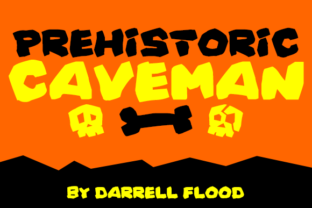
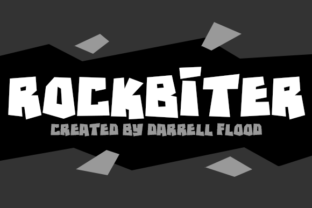
Rockbiter is an all-caps display typeface designed by Darrell Flood. Its defining characteristics—strong, angular letterforms with sharp, rugged edges—make it immediately recognizable as a font built for visual impact rather than extended reading. Unlike many decorative typefaces that soften their forms for readability, Rockbiter leans into a deliberate, chiseled aesthetic that evokes stone, excavation, and ancient inscription. The font is entirely uppercase by design, with no lowercase variant included, which reinforces its monolithic and unyielding visual personality.
For designers, developers, and project leads evaluating display typefaces, Rockbiter occupies a specific niche. It is not a versatile workhorse font suitable for body copy or long-form text. Instead, it is a specialty tool intended for headlines, titles, short branding elements, and atmospheric applications where the tone needs to communicate weight, permanence, or a raw, hand-hewn quality. Understanding this distinction is critical before committing to the font for a project.
Strengths That Define the Font
The most immediate benefit of Rockbiter is its unmistakable visual presence. The angular construction of each character creates a sense of tension and solidity. Lines are straight, corners are sharp, and curves are minimized or eliminated entirely where possible. This gives the typeface a structural honesty that aligns well with fantasy, dungeon, and mountain themes—contexts where softness or ornamentation would feel out of place.
Another strength is the font’s consistency across characters. Because every letterform follows the same angular logic, headlines set in Rockbiter feel cohesive and intentional. There is no stylistic variation between characters that might distract the eye. For projects requiring a unified, guttural voice—such as game titles, fantasy book covers, event posters, or branded merchandise for tabletop roleplaying—this consistency is a practical advantage.
The font also performs well at larger sizes. At display scales, the sharp details and rugged terminals remain legible and even gain impact. A title set in Rockbiter at 72 points or above will hold its own on a poster, a digital banner, or a book spine. The weight distribution across characters is stable, so the font does not become unbalanced when scaled up.
Tradeoffs and Practical Constraints
Rockbiter’s strengths are inseparable from its limitations. The most significant tradeoff is the lack of a lowercase set. Because the font is all caps, it cannot be used for standard sentence case text without looking like shouting or overwhelming the reader. This restricts its application to short bursts of text where the uppercase format is thematically appropriate. For any project requiring mixed case, proper nouns in lowercase, or extended reading, Rockbiter is not a viable choice.
Another consideration is legibility at small sizes. The angular, compressed forms that work so well at large scales begin to blend together when reduced below 18–24 points. Ascenders and descenders are minimal or absent, and the uniform cap height can make it difficult to distinguish certain characters—particularly I, L, and T—when space is tight. Designers should test the font at their intended output size before committing to a layout.
Additionally, the font’s strong personality means it does not sit quietly alongside other typefaces. Pairing Rockbiter with a neutral sans-serif or a clean serif requires careful attention to contrast and hierarchy. The font will dominate any composition it is part of, so it works best as the primary voice rather than a supporting element. Projects that need a layered typographic system with multiple voices may find Rockbiter too assertive for most roles.
Ideal Use Cases and Applications
Rockbiter is a strong fit for projects where the audience expects a hand-wrought, ancient, or elemental aesthetic. The following scenarios leverage its design strengths while respecting its constraints:
- Fantasy book covers and chapter titles. Whether the setting involves dwarven halls, mountain fortresses, or underground ruins, Rockbiter’s chiseled forms reinforce the thematic material without needing illustration to communicate tone.
- Tabletop roleplaying game materials. Character sheets, rulebook headers, adventure titles, and monster stat blocks benefit from the font’s dungeon-appropriate personality. It signals a world that is dangerous, physical, and old.
- Game UI headers and logo treatments. For indie or mid-budget video games with fantasy or stone-based themes, Rockbiter can serve as a logo or title screen font. It reads clearly at typical title sizes and communicates the game’s visual direction immediately.
- Event posters and flyers. Concerts, festivals, or theatrical productions with a medieval, metal, or fantasy angle can use Rockbiter to attract attention and set expectations. The font works especially well in monochrome or high-contrast color schemes.
- Merchandise and apparel. T-shirt graphics, enamel pins, and sticker designs that need short, punchy text benefit from the font’s bold, self-contained letterforms. A single word or short phrase set in Rockbiter can function as a standalone visual element.
When Alternatives May Serve Better
While Rockbiter is effective within its niche, there are situations where a different typeface may better serve the project’s needs. Consider alternatives if any of the following apply:
- Extended text requirements. If the project includes body copy, product descriptions, or narrative text longer than a few words, Rockbiter is not suitable. Pair it with a readable text font, or choose a display typeface that includes a more complete character set.
- Mixed-case or multilingual needs. Projects requiring accented characters, numerals in specific styles, or lowercase letters for grammatical reasons will need a font with broader language support. Rockbiter’s all-caps design limits its utility in international or multilingual contexts.
- Subtle or minimal aesthetic. For brands or products that require understated typography, Rockbiter’s aggressive angularity will feel overwhelming. A clean geometric sans-serif or a restrained serif would communicate neutrality or sophistication more effectively.
- Digital interfaces with small text. Mobile apps, web interfaces, or any environment where type must remain legible at 14–16 points will struggle with Rockbiter. The font’s readability degrades quickly below display sizes.
- Cost or licensing constraints. Designers working with limited budgets should verify the licensing terms for Rockbiter before beginning a project. If the font requires a paid license for commercial use, there are free or open-source alternatives with similar rugged aesthetics, such as Russo One, Black Ops One, or Josefin Sans (styled with uppercase), though none replicate the exact chiseled quality of Rockbiter.
Practical Decision-Making Insights
Choosing whether Rockbiter is right for a project comes down to a few clear questions. First, does the project’s visual tone require a font that communicates permanence, physicality, and an ancient or fantasy context? If the answer is no, Rockbiter will likely feel mismatched. Second, will the font be used exclusively at display sizes for short text? If the answer is yes, Rockbiter becomes a stronger candidate. Third, is the design team prepared to work with an all-caps-only typeface and build a typographic system around that constraint? If the project can absorb this limitation without forcing awkward usage, the font can succeed.
Another practical consideration is testing in context. Before purchasing or licensing Rockbiter, designers should create mockups at the actual output sizes and on the actual media—whether that is a printed poster, a digital screen, or merchandise. Because the font’s angular details interact differently with different substrates, a test run prevents surprises. For example, on rough paper stock, the sharp terminals may soften in a way that changes the font’s character. On a backlit screen, the high contrast of the letterforms may feel more aggressive than intended.
It is also worth evaluating how Rockbiter sits alongside other design elements. The font works best when it is the primary typographic voice and when surrounding imagery—illustration, photography, textures—echo its rugged, elemental quality. A polished, minimalist design will clash with Rockbiter’s raw personality. Conversely, pairing it with stone textures, earth tones, or high-contrast black-and-white layouts will reinforce its strengths and create a cohesive visual system.
Determining Alignment with Your Goals
For designers and project leads evaluating Rockbiter, the decision ultimately rests on how closely the font’s constraints match the project’s requirements. Rockbiter is not a universal tool, nor does it attempt to be. It is a deliberate, characterful typeface designed for a narrow but passionate audience. If your project needs a font that feels carved rather than drawn, that conveys weight rather than lightness, and that commands attention without apology, Rockbiter deserves consideration.
However, if the project demands flexibility, readability across sizes, or the ability to fade into the background, Rockbiter will fight those goals rather than serve them. The font is best approached with clear eyes: it will dominate every composition it enters, and it will not adapt to contexts that do not match its aesthetic. That honesty is a strength for those who understand what they are selecting and a pitfall for those who expect a jack-of-all-trades display font.
Darrell Flood’s Rockbiter exists to serve a specific vision. Evaluating it for your work means deciding whether that vision aligns with your own. When it does, the font becomes a powerful, cohesive voice. When it does not, the friction will be visible in every headline and every layout.