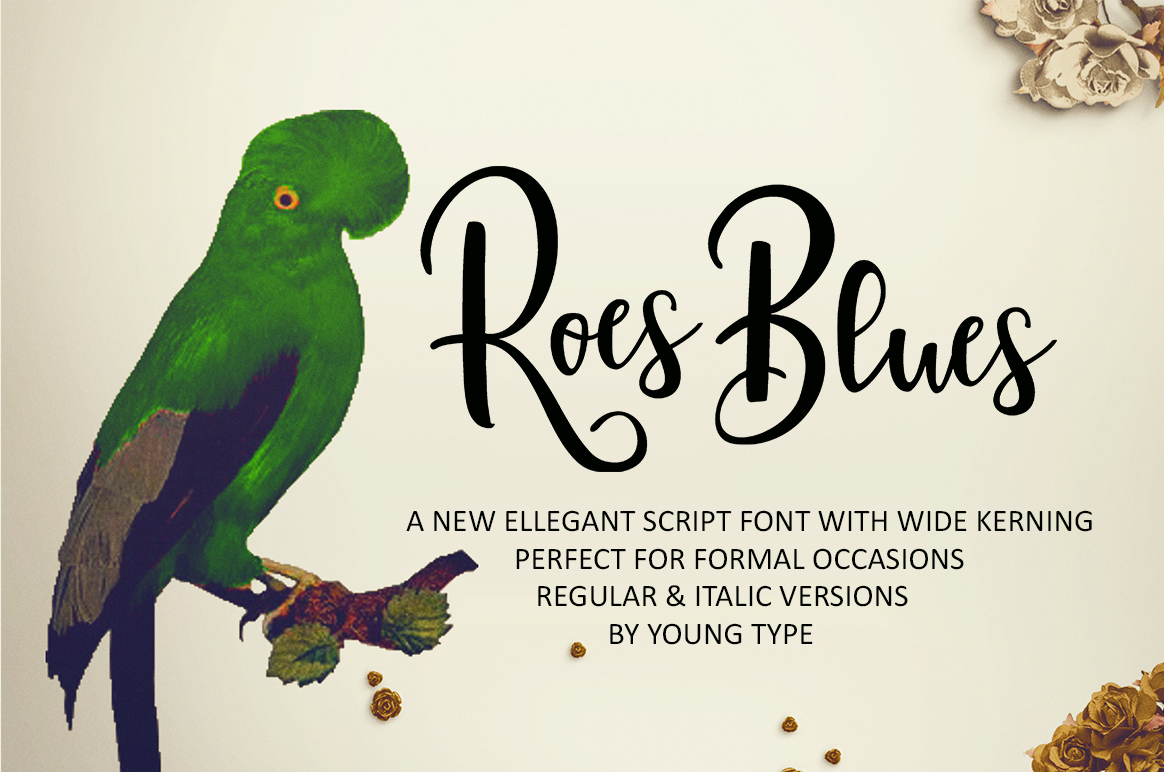
Roes Blues: A Script Font With a Modern Twist
If you’ve been searching for a typeface that blends the warmth of a handwritten font with the crispness of modern typography, Roes Blues might be exactly what you need. It’s a script font, but not the kind that feels overly decorative or hard to read. Instead, it brings a crispy flow to every letter, making it suitable for everything from logo design to social media graphics. Packed with alternate characters, it gives you creative freedom without forcing you to settle for generic letterforms.
What Makes Roes Blues Different
At its core, Roes Blues is a display font with a personality that sits somewhere between sophisticated and approachable. The strokes are smooth, but not overly curvy—they have a controlled rhythm that feels modern. The “crispy flow” means the transitions between thick and thin parts of each letter are sharp and precise, avoiding the muddiness you sometimes see in handwritten fonts. This makes it especially useful when you want your text to stand out without sacrificing readability.
The font includes a generous set of alternates. So if you’re designing a logo or a short headline, you can swap a default character for a swash or a stylistic variant that better fits the mood. This is a huge help when you’re trying to avoid repeating the same letter shape, which can make a word look unnatural. For example, in a brand name like “Blissful Bites,” you can use different forms of the letter “s” to create a more organic, handcrafted feel.
Where Roes Blues Really Shines
Because it’s a script font with a modern edge, Roes Blues works across many creative and commercial projects. Here are a few places where it delivers the most value:
Branding and Logo Design
If you’re a brand strategist or entrepreneur working on a new identity, you need a typeface that feels distinctive but not distracting. Roes Blues fits that balance. Its moderate weight and clean curves make it legible even at small sizes, which is critical when your logo needs to appear on a business card, a website header, or a product label. The alternate characters let you customise the logo so it doesn’t look like it came from a standard template.
Packaging Design
For packaging, especially for artisanal or premium products, a script font can communicate handcrafted quality. Roes Blues avoids being too flowery, so it works on product boxes, jars, and bags without overwhelming the overall design. Pair it with a simple sans serif font for product descriptions, and you get a clean hierarchy that customers can scan quickly.
Social Media Graphics and Web Design
Digital content creators and marketers will appreciate how Roes Blues holds up on screens. The crisp outlines reduce the fuzziness that can happen with script fonts on low-resolution displays. Use it for quote cards, Instagram stories, or YouTube thumbnails. It also works nicely as a heading font on a website, provided you keep body text in a neutral serif or sans serif to avoid overloading the page.
Editorial and Publishing
For bloggers, publishers, and editorial designers, Roes Blues can add personality to pull quotes, section headers, or even a masthead. It’s not meant for long body copy—no script font is—but it excels at drawing the eye to key moments in your content. Combine it with a clean serif font like a classic Georgia or a modern slab serif for a balanced look that feels curated.
How Roes Blues Affects Readability and Brand Perception
Choosing a script font always raises questions about legibility. But Roes Blues has been designed with enough letter spacing and distinct shapes that readers won’t strain to understand short phrases. The “crispy flow” ensures that characters don’t bleed into each other, which is a common problem with handwritten fonts that try to look too natural.
From a brand perception standpoint, using Roes Blues can signal that you care about detail. It feels considered, not casual. If you’re a small business owner aiming to project professionalism with a touch of creativity, this font helps you avoid the sterile look of basic system fonts while still looking serious. It’s not childish or overly ornamental—it’s a contemporary script that respects the reader’s time.
Visual hierarchy gets a boost too. Because the font has a strong personality, it naturally anchors the most important part of your design. Use it for the headline, and let your secondary text live in a more neutral typeface. That contrast guides the viewer’s eye exactly where you want it.
Practical Guidance for Using Roes Blues
Before you download and start using Roes Blues in every project, take a moment to think about fit. Here’s a step-by-step approach based on real project experience:
Evaluate Your Project’s Tone
Roes Blues works best when the tone is warm, confident, and slightly refined. If your project is ultra-serious (like a legal document or medical report), a script font will feel out of place. But for lifestyle brands, creative agencies, event invitations, or food-related businesses, it’s a natural choice. For example, a wedding stationery suite would benefit from its refined swashes, while a coffee shop’s packaging would get a cozy, artisan feel.
Test Font Pairings
Pair Roes Blues with a clean sans serif like Montserrat, Lato, or Inter for a modern contrast. If you want a more classic look, try a serif font like Merriweather or Playfair Display. The goal is to create differentiation—script for emphasis, and a simple partner for readability. You can also pair it with another handwritten font, but only if that second font is extremely restrained (like a subtle monoline script) to avoid visual chaos.
Review the Alternate Characters
When you install Roes Blues, take the time to browse its glyph set. Many design applications (like Adobe Illustrator, Photoshop, or Canva) allow you to access alternates via a glyph panel or OpenType features. Use different endings and swashes on letters at the start of a sentence or in a logo. But don’t overdo it—using too many alternates in a single word can break the flow. Stick to one or two stylistic choices per word to keep it natural.
Check Readability at Different Sizes
Because Roes Blues is a display font, it’s best at sizes above 18pt for digital and above 14pt for print. At very small sizes, the thin strokes might get lost, especially in print. Always test your design at the actual size it will be viewed—whether that’s on a mobile screen or on a product label. If you need to use it small, consider removing alternates and sticking with the default characters for better consistency.
Understand Commercial Licensing
If you plan to use Roes Blues in client work, merchandise, or any commercial project, make sure you have the right license. Most premium fonts sold through reputable marketplaces come with a standard commercial license that covers most small to medium business needs. But always read the fine print: some licenses restrict usage in certain mediums like broadcast or app embedding. If you’re a designer, save the license file with your project files so you can prove compliance later.
Real-World Examples and Observations
Let’s paint a couple of scenarios. Say you’re a marketer creating a landing page for a boutique subscription box. You use Roes Blues for the hero headline: “Your Monthly Dose of Self-Care.” The script font immediately conveys a personal, thoughtful service. Below, in a clean sans serif, you explain what’s inside. Visitors see the contrast and feel the brand is both warm and professional.
Or imagine you’re a crafter designing custom stickers for a small shop. Roes Blues on the phrase “handmade with love” gives each sticker a unique, hand-lettered appearance without you needing to write it out dozens of times. The alternate characters keep each sticker slightly different, which adds to the artisanal feel.
From a design observation standpoint, I’ve noticed that Roes Blues pairs especially well with muted color palettes—think earthy greens, warm beiges, or dusty blues. The font’s modern twist stands out more when the background is minimal. If you put it over a busy pattern, the crisp flow can get lost, so reserve it for clean compositions.
Final Thoughts on Choosing Roes Blues
Roes Blues is not a do-everything font. But for the right projects—branding, packaging, editorial highlights, social media—it offers a level of polish that generic script fonts lack. The alternate characters give you a custom feel without hiring a lettering artist, and the modern, crispy flow ensures your message comes through clearly.
Whether you’re a designer building a brand identity, a small business owner creating marketing materials, or a content creator sprucing up your visuals, give Roes Blues a try in a mockup first. See how it interacts with your other design assets. If it feels natural and elevates your work without shouting for attention, you’ve found a versatile tool for your creative toolkit.